WHAT DOES THE GMAT MEASURE?
The GMAT is an aptitude test. Like all aptitude tests, it must choose a medium in which to measure intellectual ability. The GMAT has chosen math, English, and logic.
The question is — does it measure aptitude for business school? The GMAT’s ability to predict performance in school is as poor as the SAT’s. This is to be expected since the tests are written by the same company (ETS) and the problems are quite similar (though the formats are different). However, the GMAT also includes two types of questions — Arguments and Data Sufficiency — that the SAT does not. Many students struggle with these questions because they are unlike any material they have studied in school. However, the argument and data sufficiency questions are not inherently hard, and with sufficient study you can raise your performance on these questions significantly.
No test can measure all aspects of intelligence. Thus any admission test, no matter how well written, is inherently inadequate. Nevertheless, some form of admission testing is necessary. It would be unfair to base acceptance to business school solely on grades; they can be misleading. For instance, would it be fair to admit a student with an A average earned in easy classes over a student with a B average earned in difficult classes? A school’s reputation is too broad a measure to use as admission criteria: many students seek out easy classes and generous instructors, in hopes of inflating their GPA. Furthermore, a system that would monitor the academic standards of every class would be cost prohibitive and stifling. So until a better system is proposed, the admission test is here to stay.
FORMAT OF THE GMAT (CAT)
The GMAT is a three-and-one-half hour computer adaptive test (CAT). There are four sections in the test.
| Section | Type | Questions | Time |
| 1 | Math | 21 | 45 minutes |
| 2 | Verbal | 23 | 45 minutes |
| 3 | Data Insights | 20 | 45 minutes |
You can choose the order in which the sections of the test appear.
The GMAT is a standardized test. Each time it is offered, the test has, as closely as possible, the same level of difficulty as every previous test. Maintaining this consistency is very difficult—hence the experimental questions (questions that are not scored). The effectiveness of each question must be assessed before it can be used on the GMAT. A problem that one person finds easy another person may find hard, and vice versa. The experimental questions measure the relative difficulty of potential questions; if responses to a question do not perform to strict specifications, the question is rejected.
The experimental questions can be standard math, data sufficiency, reading comprehension, or arguments. You won’t know which questions are experimental.
Are you ready for the GMAT?
With our comprehensive book, you can be sure!
Although the GMAT is difficult, it is very learnable. GMAT Prep Course presents a thorough analysis of the GMAT and introduces numerous analytic techniques that will help you immensely, not only on the GMAT but in business school as well.
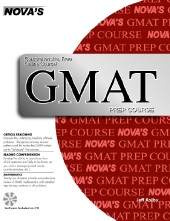
Nova’s GMAT Prep Course is the best GMAT prep book available, providing the equivalent of a 50-hour, 6-week course. This comprehensive test prep book provides twenty-two chapters of review material and hundreds of GMAT-style practice problems and examples. Plus, we’ll take you inside the heads of the test question writers to help you understand and outsmart the GMAT question mentality.
Dedicated preparation with Nova’s GMAT Prep Course has been shown to significantly increase GMAT scores. If you want to get your best score on the GMAT, you can’t afford not to try it!
Features:
- Math: Twenty-two chapters provide comprehensive review of GMAT math.
- Logical Reasoning: Discover the underlying simplicity of these problems and learn the tactics the GMAT writers use to obfuscate the answers.
- Reading Comprehension: Develop the ability to spot places from which questions are likely to be drawn as you read a GMAT passage (pivotal words, counter-premises, etc.).
- Mentor Exercises: These exercises provide hints, insight, and partial solutions to ease your transition from seeing GMAT problems solved to solving them on your own.
- Test Mentality: 15% of this book is dedicated to training you to think like a test writer to help you spot red herrings AND correct answers.
- Hundreds of GMAT-style questions with detailed solutions!
- Study plan suggestions based on the amount of time you have before the exam
Testimonials:
“Far and away the best book…After doing all drills in Nova, the commonly considered difficult practice questions in Kaplan were almost a joke. I would recommend to anyone this book.”
“I got a 690 on the GMAT using only this book, and studying sporadically for a few weeks leading up to the test.”
“I am very happy to say that at the GMAT exam, for which I studied with this book, I received 710 points.”
“I am a Professor of English, and… I make it my business to find books and use them to help students get into graduate school. I have found the Nova book complete in every aspect… Without unnecessary rhetoric, the text is exact, with comprehensive yet concise answers, in the math and verbal sections.This is definitely a three year crash course in a several month program.”
Pages 602
Price: $23.97
ISBN: 1889057401
Purchase GMAT Prep Course (Domestic) (printed book) (Free shipping within the United States.) (We do not ship outside of the United States.)
SCORING THE GMAT
The three parts of the test (Quantitative Reasoning, Verbal Reasoning, and Data Insights) are scored independently and contribute equally to your total score (205 to 805).
In addition, you will be assigned a percentile ranking, which gives the percentage of students with scores below yours.
GUESSING
If you can eliminate even one of the answer-choices, guessing can be advantageous.
ORDER OF DIFFICULTY
Most standardized paper-&-pencil tests list problems in ascending order of difficulty. However, on a CAT test, the first question will be of medium difficulty. If you answer it correctly, the next question will be a little harder. If you answer it incorrectly, the next question will be a little easier. Because the GMAT “adapts” to your performance, early questions are more important than later ones.
FREQUENTLY ASKED QUESTIONS
When is the GMAT given?
The GMAT is given year-a-round during normal business hours. There is often one week during each month in which the test is not offered.
How important is the GMAT and how is it used?
It is crucial! Although business schools may consider other factors, the vast majority of admission decisions are based on only two criteria: your GMAT score and your GPA.
How many times should I take the GMAT?
Most people are better off preparing thoroughly for the GMAT, taking it one time and getting their top score. You can take the GMAT as often as you like, but many business schools will average your scores. You should call the schools to which you are applying to find out their policy. Then plan your strategy accordingly.
Can I cancel my score?
Yes. When you finish the GMAT test, the computer will offer the option of canceling the test or accepting it. If you cancel the test, neither you nor any school will see your score. If you accept the test, the computer will display your GMAT score and it will be available to all schools.
Where can I get the GMAT registration forms?
Most colleges and universities have the forms. You can also get them directly from the Graduate Management Admission Council by writing to:
Pearson VUE
Attention: GMAT Program
PO Box 581907
Minneapolis, MN 55458-1907
or calling 1-800-717-4628
